


The Economist recorded 50 pilot shows ahead of the launch of its premium video and newsletter strand Insider, executive editor Andrew Palmer has revealed as he spoke about the brand’s video strategy.
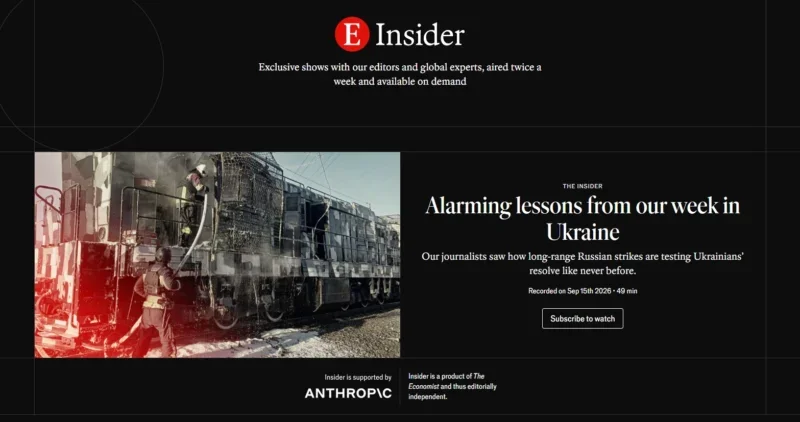
Economist Insider launched in October as a twice-weekly long-form video show on the website or app, with accompanying newsletters. It includes a weekly news analysis or interview show hosted by editor-in-chief Zanny Minton Beddoes alongside four other monthly journalist-led shows that rotate each week. They are: Inside Tech, Inside Economics, Inside Geopolitics and Inside Defence.
The pilot process paid off: the launch of Insider led to The Economist being named Publisher of the Year at Press Gazette’s Future of Media Awards this month.
The Future of Media Awards judges said: “The Economist launched an on-demand, premium video product that showcases the spirited debates and candid conversations behind its world-class journalism.
“This feels like the future of journalism for such an established and trusted voice in publishing.”
Economist Insider is currently included within the core Economist subscription (full price of £279 per year). However The Economist is now trialling a lower-priced subscription (around half the price) called “Play” in Canada, Denmark, Norway and Sweden for its audio and video products. This includes Insider as well as its paywalled podcasts.
The Economist’s executive editor Andrew Palmer told Press Gazette’s Future of Media Technology Conference that Play’s video and audio proposition seems to be having a “halo effect” as people in those pilot markets are “subscribing in higher numbers to the core proposition”.
Economist fit Insider ‘into rhythm of existing newsroom’
Palmer said Insider was launched “because it showcases humans” and that this matters “as AI encroaches more and more.
“It builds a connection: we definitely have a lot of subscribers who want to see what our journalists do and understand the workings of the newsroom.”
Palmer said there had been a “big hiring drive” around video staff, with investment extending to the building of new studios. He said The Economist had deliberately not brought in new hosts from outside the newsbrand but that it was a lengthy process to decide what worked and what didn’t.
“They are existing journalists doing their reporting, writing the columns, editing the paper… We did 50 pilot shows before starting to launch. There’s a very long process of working out what is the format, who’s good on camera, who’s not, and how does this work. And that was our way of kind of filtering the talent. It was an internal process.”
The Economist decided not to build something totally separate to its main output and was wary of bringing in younger creators or influencers with no connection with the brand, Palmer said, as some publishers from the Daily Mail to Future have experimented with.
He said: “We take the institutional heritage, very high trust brand seriously… We have a very coherent world view, so there’s danger in fragmented people coming in or outsiders coming in saying things on our platforms. So we have tended to fit the Insider into the rhythm of the existing newsroom.”
On the day Palmer was speaking, The Economist released an episode of Insider titled “Is Islamism a threat to Europe?” with a panel of its journalists from the UK and Europe discussing an issue that tied into its leader column in the magazine, explaining why the brand had reached the view that it did.
Traditionally The Economist has eschewed bylines. But with its videos, podcasts and newsletters this has changed over the past few years.
Palmer said “people need a little bit of training” to get used to doing it, but spoke about grappling with how much of a journalist’s personality should go into the work.
Palmer, who writes The Economist’s work and management column Bartleby, hosts a podcast called Boss Class. He said: “The first thing that someone said to me on the producer side was ‘Who are you going to be when you’re hosting?’
“It was such a weird question to me. Like, ‘What do you mean? Why can’t I just be me?’ And they obviously thought that’s a catastrophic idea. So we’re grappling with a whole new set of questions, which we just didn’t have to as behind the screen text-based journalists.”
However the benefit of producing this type of content, Palmer said, is “showing existing subscribers who the journalists are and how we work”.
Economist Insider has subscribers ‘at its heart’ but other commercial benefits too
“At its heart”, Palmer said, Economist Insider is designed to support the subscriber proposition and he added there was “good evidence” the videos and newsletters together are leading to better engagement. He said it is also “an acquisition vehicle”, both via the core Economist subscription and Play.
Another benefit, Palmer said, is “awareness”, pointing to the 85-minute interview between Minton Beddoes and Elon Musk published in July, which has more than six million views on Youtube. “That ricocheted around the internet the way it wouldn’t have been done for us before.”
The Economist publishes select Insider interviews in full on Youtube and is pointing viewers to the full subscription offering in the comment sections.
Finally, Palmer said, Insider means new opportunities for advertising and sponsorship revenue. The entire Insider section is currently sponsored, or “supported”, by AI company Anthropic. A disclaimer states: “Insider is a product of The Economist and thus editorially independent.”
Email pged@pressgazette.co.uk to point out mistakes, provide story tips or send in a letter for publication on our "Letters Page" blog
